The shocking video of a counterfeit Sparco harness failing in a 50 mph impact should say it all:
Companies like Sparco and Sabelt, Momo spend millions to engineer products you are entrusting your life to, is saving a few bucks buying from some anonymous unauthorized and unscrupulous dealer on eBay or Facebook really worth it?
Yup, we brought you fake Brembo big brake kits before, now brace yourselves for fake harnesses. I'm sure fake seats, helmets, nomex are all out there at prices too good to be true.
Caveat Empor.
(via Carmarthenshire County Council and BTG)
Showing posts with label safety. Show all posts
Showing posts with label safety. Show all posts
October 20, 2015
August 28, 2015
Speed limits for track days is a terrible idea

Recently Road & Track published an article suggesting speed limits be imposed at Track Days and "Driving Schools". It got a quite a bit of play and discussion but,
It's a terrible idea.
The proposal is a 90 mph limit for beginners and 100 mph for experienced drivers.
It should be fairly obvious speed limits on a race track situation are unenforceable. Speed gun every car and pull over all offenders? Install GPS devices into every car to be individually checked after each session? How?
The reason given for this is that today's cars are so capable that they are much faster than race cars of the past, minus the safety gear.
That is indeed true for speed and handling, yet a modern 2015 road car with 27 airbags and assorted safety feature might protect the occupant better than a 30 year old home built race car.
Given how track days are run by hundreds of different organizations, arbitrary speed limits will just drive clients to the "no speed limit" companies.
In all my years on track I have seen quite a number of crashes but I can can only think of one that happened on a straight and that was because of rain. Most happened at speeds under 90 mph.
Heck, I've seen a bunch of cars totaled on parking lots while dodging cones at 60 mph!
Controlling a student is the job of the instructor and it is the job of the organizing entity to put him in a condition to do so.
Want to improve safety?
Don't cram sessions so that instructors have more time with their students before and after sessions.
Vet your instructors more carefully, let's be honest, many are there just for the free track time and some for the ego trip. Really great instructors are rare.
Want to slow cars down?
Build temporary chicanes with cones for beginner students. Industry events for motoring journalists do versions of this. It will not be popular but that's the proper way to limit approach speeds to corners.
Don't allow slicks and r-comps for beginners.
Organize skid pad sessions!
The article cites the death of several instructors but it's worth noting that none of those deaths were caused by excessive speed as much as by borderline criminal negligence of circuit owners and organizers:
The death of the instructor in Florida at the now defunct Disney Raceway can be blamed on the jackass who decided it would be ok to run the track backwards.
The death at Summit Point Raceway's Jefferson occurred on a low speed "fun drive" event and highlighted the need for tracks to get their act together when it comes to safety, trees should be nowhere a car could even remotely hit them. Summit Point, fun track that it is, has had safety standards straight from the 1960s.
It's up to the consumer to understand the safety level of some of these tracks: you could drive 150 mph all day at COTA and be safe, you could get in big trouble at 60 mph elsewhere. Organizations have to demand higher standards from tracks.
Of course on the opposite end is economics: it's a fact many tracks are struggling financially, new tracks are being built in the Country Club model, not open to the public.
Insurance premiums have gone up at least 35% this past year, yet reputable organizers have no way of proving their events are any more or less safe than Sideswipe Bob's Open Track Mayhem Circus.
There is no sanctioning body in the US that can grade procedures and quantify risks for each event.
Two ways to go here: in the UK, our friends at Destination Nurburgring, tell us how they must submit to their insurers detailed descriptions and risk assessments for each event. A lot of paperwork but help comes via the Motor Sport Association, a national organization regulating motorsport activities, it furnishes certifications to underwriters. By providing standards, the MSA helps both organizers and insurers.
The opposite would be Italy where tracks have their own coverage and they don’t ask organizers be insured. The person we spoke with said that in any case, coverage for these activities is so sketchy there, that chances of a company paying out are almost nil.
You are essentially on your own.
Take you pick but arbitrary speed limits are definitively not the right solution.

August 22, 2015
Spa chewed up and spit out a few people on Saturday.
 |
| De Jong was a lucky boy to escape without major injuries |
On Saturday, Spa did its best to disprove those who think Motorsport has become too safe.
Fortunately for those involved, fate and modern safety standards won out and none of the drivers involved suffered serious injuries in what, not that many years ago, would have been fatal crashes.
You could successfully argue that in more dangerous times nobody would have been crazy enough to try an outside pass into Blanchimont as Daniel De Jong did. Given the choice however, I'll take the modern safety standards and the crazy drivers any day.
GP3 saw Jann Mardenborough spit out by Raidillon after losing it on the climb up from Eau Rouge.
It's the second huge crash for the Playstation GT Academy graduate this year, the other being the tragic flip at the Nürburgring in the Nissan GTR.
Porsche Supercup was not immune. Here, Michael Ammermueller inexplicably understeered off the track, again at Blanchimont, destroying his 991 GT3 Cup.
It wasn't just the drivers, circuit organizers had the bright idea to put ridged curbs on the outside of Raidillon. The intent was to punish those who exceeded track limits but I'm pretty sure they miscalculated...
Sanity prevailed and those rumble strips have been removed.
July 3, 2015
You be the Steward: Track Position

Let's put you, the reader, in race steward shoes again. This time it's four rather than two wheels and the consequences of the on track action, spectacularly more severe.
Challenge Car Racing is a independent racing series with no affiliation with Ferrari, it is high end club racing for owners of Challenge cars of different vintages, from 355 to 458. Round four of the series took place at Road America as a support to Pirelli World Cup.

The Ferrari 458 driven by Jim Booth and the 430 of Steve Hill touched on what on a track map looks like a straight but in reality is a significant left kink approaching the turn 5 braking zone.

The resulting video is both one of the most spectacular and graphic depictions of a crash ever recorded thanks to the multiple cameras on Booth's car and a testament to great engineering at Maranello: the driver walked away from a 150 mph crash, the 458's front and back windows still completely intact.


But now you make the call: would you rule against the black 430 for blocking or the red 458 for sticking its nose where it should not have been?
June 20, 2015
The Flip Side of Great Car Safety.

There has been much talk lately about bringing back danger into Formula 1 specifically and racing in general.
The amazing advances in crash survivability, thanks to the FIA's strict standards extending through all its sanctioned open wheel formulas, have made crashing almost consequence free.
Obviously no sane person would advocate making cars less safe but the unintended consequence of eliminating Darwin, if you will, from the equation is that we are breeding generations of racers that think it's perfectly fine to behave like asshats while racing.
For your consideration, via WTF1, watch Frenchman Brandon Maisano push American Gustavo Menendez off the track in a recent Formula 3 race at Spa.
Melendez was unhurt but this is how things are going down in the minor formulas this year.
Here is Maisano's fellow Ferrari Academy pupil, Lance Stroll, pushing Antonio Giovanazzi onto the grass and getting the worst of it.
The same Giovanazzi tangled with American Santino Ferrucci last year at Spa.
In any case, you can search for more on YouTube but you get the gist: it's great nobody was hurt and we know all these kids are desperate to emerge from the pack but, is that the way to behave?
Recently, I was listening to an interview with Ivan Capelli on the excellent PitTalk podcast from F1Sport. Capelli and the hosts were reminiscing about the Portuguese GP of 1988 when he passed Senna for the lead of the race despite an underpowered March, his moment of glory.
Capelli and Senna raced karst together, Ivan said, and Ayrton was a tough racer but at least on that occasion was fair, recognized he was beat and gave him enough space.
There was a code among drivers back then he continued, in part because they had all grown, professionally, with the awareness of consequences.
The dilemma is: cars and tracks have been made safe, great because nobody want to see someone die in a motor race but how do you instill that code in teenagers without castrating racing with penalties for every minor contact, hoping to prevent the big ones?
June 5, 2015
Survey: Virtual Safety Cars in real world racing.
 |
| (Getty Images) |
The issue of a race car hitting a safety vehicle has raised its ugly head again and with it, question of a more widespread use of a Virtual Safety Car.
In the very closing stages of the IMSA / United Sports Car race in Detroit, the TRG-Aston Martin Racing 007 driven by James Davison crashed into a safety truck which had pulled out on track to attend to another car which had just gone into the barrier.
Fox Sport's coverage of the incident was pretty lousy but we spoke with out friend, current Pirelli World Challenge GTA championship leader and MOMO boss Henrique Cisneros, who was trackside.
Cisneros confirmed it had started to rain lightly on the penultimate lap but, as the leaders were making their way through for the final time, it started pouring.
The Brumos Porsche slid off into the tires in the first corner of the last lap but the 23 Porsche of Mario Farnbacher and the 007 of Davison were still racing for position when the safety vehicle was deployed on the still hot track.
A local yellow was being waved at start finish which meant drivers could race all the way to that yellow.
It's not an isolated incident, at the Pirelli Challenge race in Bowmanville Ontario, this happened
There are some obvious questions:
Why no full course yellow (double yellow) with the conditions or/and a vehicle on track?
The track was wetter where the incident occurred than further away, all drivers were on slicks, pits were closed. Organizers were aware of this, did they feel pressure to not end the race under caution?
Why did the Aston driver not slow down?
If the yellow at start finish was the first yellow he encountered, by the rules, he was entitled to race all the way to that station. Perhaps he was warned by his crew about conditions but it was the final lap and a pass for the win was possible.
Was there enough time for Race Control to react and would a Virtual Safety Car had been a solution?
As you know the concept of a Virtual Safety Car was introduced in WEC last year and adopted by F1 this season as a response to Jules Bianchi's accident in Japan in 2014, one very similar to this one in its dynamic. An expansion of WEC's "Code 60" zones, it essentially freezes competitors in their current positions and separations as they they continue to make their way around the circuit at reduced speeds.
An advantages of a VSC over a traditional Safety Car, or even a full course yellow, is that it's faster to deploy and takes options away from drivers who cannot rush to close a gap.
Drivers leading the race like it because it allows for clean up yet maintains their track position. Obviously those in the back don't like it for the opposite reason but it certainly is a good toolfor race control to have in situations where everything needs to be slowed down quickly.
Should VSC be introduced in more series? Is it a good system and could VSC take the place of a physical one or should, as per F1 rules, a Safety Car always be used the moment any rescue vehicle is on track.
A Safety Car can reboot a race making it potentially more entertaining, should a VSC period always be followed by a SC picking up the leaders and bunching the field?
As always we welcome your comment as will the Motorsport Safety Foundation who have launched a survey on the subject I encourage you to fill out.
April 13, 2015
What kind of Mickey Mouse organization allows cars to run tracks the wrong way?


Another instructor was killed at a track event because owners refuse to do the right thing.
I really don't want to hear from the "Motorsport is dangerous" crowd, most of them probably don't race or instruct and in any case there a clear line between dangerous and plain idiotic.
 I don't know the company, Exotic Driving, that ran this particular event, it seems to be one of those "experience" organizations that include the MSRP with the cars specs. but the track is owned by Disney and operated by Richard Petty a name that should carry a modicum of respectability and responsibility beyond cashing checks.
 Evidently Disney allowed someone to decide it would be fine to run cars clockwise on a track designed to be a counterclockwise oval and Exotic Driving was fine with it.
What could possibly go wrong?
February 12, 2015
Animals and race tracks don't mix, revisited.


 In fact, there are a couple other seemingly obvious yet easily improvable safety issues at Mount Panorama, the unprotected concrete walls at the top of the course screaming for some Tecpro barriers come to mind but, lets just stick to animals.
All too often, criticism of safety is met with a refrains along the lines of "that's the way it is, you can't do anything about it" and "racing is supposed to be dangerous".
 Bathurst 12 hour organizers have been trying to do something about the kangaroo issue. Last year they proposed culling the skippies but that met with the displeasure of animal lovers and those who think 180 pound marsupials are a quaint feature of the Mount Panorama circuit. Safe to say most of those complaining are not racers.
 This year's plan involved snipers, because involving high powered rifles on a circuit where fans strategically bury beer to circumvent a 24 per person limit, well, what could possibly go wrong?
Most tracks have fencing. A novel idea, I know and one that is usually unpopular with organizers because it costs money. Curiously though organizers are usually not shy about fences when it comes to keeping non paying fans from getting a glimpse of the action.
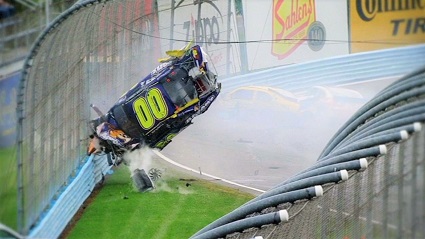 Fences have the added advantage of keeping cars out of the woods and any flying bits out of the spectator stands and it's fair to the kangaroos.
I'm going to go out on a limb and say Anthony Gilbertson is in the "build a fence camp" after smashing into a kangaroo at 220 km/h. with his BMW in the opening phases of this year's Bathurst 12 Hour.
It's not pretty,
(hat tip to Dominic Carey for finding the clip)
January 12, 2015
Miracle at the Dakar?

Unbelievable new amateur footage of Canadian Matt Campbell's crash at the seventh stage of the Dakar in Bolivia.
Thanks to modern safety standards and a car that spent so much time spinning in the air rather than hitting things, none of the three man crew was seriously hurt but, considering the crowd that was helping recover a previous wreck, a different bounce, a few meters over this way and it could have been a massacre.
October 10, 2014
Charlie Whiting confirms nobody lifted.
 In a press conference held at Sochi Friday evening, in the presence of FIA President Jean Todt, F1 Race Director Charlie Whiting confirmed what many suspected: none of the racers slowed down much for the double yellow flags which were flown in Sector 7 at Suzuka following Sutil's accident.
Official confirmation of what was fairly obvious just from looking at data displayed on the F1 app.
As a consequence, F1 will be looking into options to take speed control in these situation away from drivers. This would likely result in a procedure similar to Endurance Racing's Code 60 which mandates a maximum speed through a problem area.
Aside from this, journalists present were shown CCTV footage of the crash which, as Sky Sports Ted Kravitz reported, showed Bianchi had a tank slapper before he went off and hit the recovery crane. No sign of mechanical failure has been detected so far.
The FIA once again was forced to confirm (and I can't believe anyone working in F1 media still asked about it) that the Green flag seen in the video clips was indeed correctly displayed.
There was a mention of looking into fitting recovery vehicles with some sort of protective skirt and that the vehicle was dispatched by Race Control.
Whiting denied late starting time for the race was a factor although they had offered the organizers a chance to move it up.
Whiting shot down Felipe Massa's assertion that he was "screaming on the radio" for race direction to stop the race.
There was no talk of canopies.
October 5, 2014
Jules Bianchi's accident casts a pall over the Japanese GP
 |
| The look on Rosberg's, Hamilton's and Vettel's faces said it all. |
 |
| Alessio De Marco |
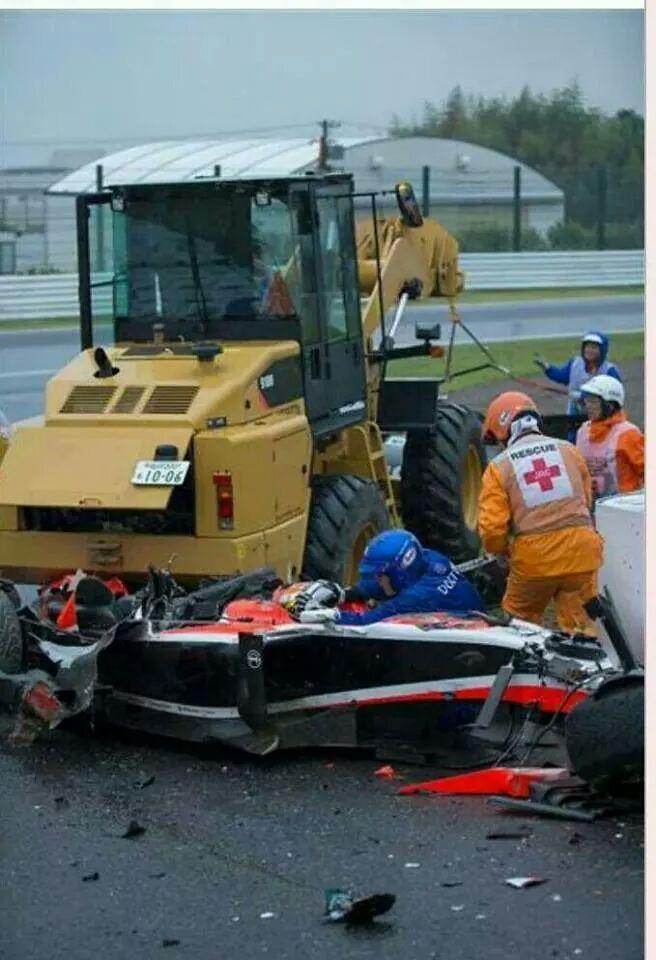
Lates word is that he's out of surgery and in intensive case. His roll bar failed in the impact with the crane which was removing Sutil's car, which had gone off moments earlier.
There will inevitably be controversy because you can argue hitting a heavy machine is much more dangerous than hitting another F1 car. Perhaps the organizers should have waited for the cars to be all under Safety Car before bringing the crane in. Perhaps the Safety car should have been called out earlier. Perhaps Bianchi just did not realize the yellow was out or simply could not see it.
But it guess to show you how despite all effort and amazing advances, racing will never be "too safe".
All our best wishes to Jules.
September 25, 2014
That 136 mph crash at COTA, in first person.
 |
| Tim Bell/Facebook |
Pay close attention at how cool Tim Bell stays in the 10 seconds between the time he first realizes he has a problem with the brakes and the impact.
The description in the video says the car hit at 136 mph and if Tim was not hurt it's thanks to the TecPro barriers installed at the Circuit of the Americas. Notice how, despite the speed, there relatively little visible damage to the Nissan 370Z.
TecPro is a french company which has developed a system of foam filled plastic barriers joined by nylon straps that first originated in karting. The barriers are more expensive than tires but require much less maintenance than a homologated tire wall where tires have to be bolted together and contained by as conveyor belt. Tim will attest to their effectiveness.
September 19, 2014
The importance of proper barriers.

The team behind Circuit of the Americas did a stellar job building a world class facility, the only FIA F1 Certified track in the United States.
FIA certification means a very high level of safety incorporating all the latest advances in the field But, to all those who still insist safety equates to less excitement, let me show you how all that work paid off today.
I would bet you Tim Bell, the Nissan 370Z driver racing in the Continental Tire Sports Car Challenge series, did not find it boring at all.
In this case, the paved runoff made things worse but the FIA barriers did a superb job absorbing the impact. Contrast this to the recent crash at Watkins Glen.
A stack of tires, bare armco, just don't not cut it anymore and it's really up to all of us racers and enthusiasts to demand every track make the effort to upgrade. This is why Axis is fully behind efforts of the Motorsport-Safety Foundation and the Sean Edwards Foundation.
We're guessing Tim Bell will be too.

August 15, 2014
Smoke in your eyes

Almost the totality of media immediately convicted with headlines that included some form of "...Stewart killed..."
Only Tony Stewart and perhaps an onboard camera know what happened with certainly but at the time I, like almost everyone I know who is in any way involved in motorsport, wondered why Kevin Ward Jr. would crawl out of a wreck and run around a live racetrack looking for a fight with a moving car.
Clearly, I'm not a oval racing enthusiast...
Now, aside from a shocking lack of any safety protection for infield workers, public or drivers, as pointed out by Motorsport Safety Foundation's founder Henrique Cisneros, I would argue that when you have a form of racing where policemen are regularly on hand to restrain drivers, you have a systemic problem.
Motoring journalist Jack Baruth, explores in a piece in his personal blog:
...I think young Mr. Ward knew this was his chance to get on television and raise his profile as a driver. I think it was a calculated move. I think he wanted to maximize a situation. Face it — even if Stewart hadn’t hit him, it would have made highlight reels and would have put his name on people’s lips...
...So Kevin Ward, Jr. saw a chance to make a name for himself. To get lucky. To be the kid who faced down Tony Stewart on the highlight reel. But in his haste to do that, he didn’t think about the risks. Which, I would add, is a characteristic of nearly all successful drivers. If you sat and thought seriously about the risks, you’d never go wheel-to-wheel racing at all. He made a quick decision, a judgment call. That’s the way racing works.
It cost him his life.
Wasn't Kevin Ward Jr. trying to give what so many of those so quick to condemn Tony Stewart, exactly what they wanted?
Certainly, it was not racing because crowds are regularly whooping and hollering with delight at this kind of crap.
July 15, 2014
A former F1 doctor speaks.
Gary Hartstein, the badass, cigar smoking doctor who was Formula One's Medical Delegate from 2005 to 2012, has been very much in the public eye in the first half of this year because of his frank, sometimes brutal, comments about Michael Schumacher's medical outlook after his skiing accident.
His articles on the subject were a respite from the tidal wave of non scientific drivel and misinformation printed about Schumacher and head injuries in both the mainstream media and in the tabloids.
Hartstein eventually got a quite a bit of flack for it, very unfairly in our opinion, mostly from those for whom the grim reality of scientific data did not fit a wish of a happy ending scenario for the German champion.
The Doc finally became fed up of being misquoted and stopped discussing it. But all that needed to be said, was.
This interview, part of the same ShakeFree series as the Derek Warwick clip you saw recently, was shot before that all happened.
Along with remembrances of Professor Watkins and speculations about what led to his dismissal by Jean Todt, there is a section where Hartstein talks about how F1, thanks to the application of scientific method has, since 1994, become very low on the list of dangerous sports.
No small irony ironic that one of its greatest champions, after twenty years in the sport, was so injured in a mundane activity.
Hartstein also makes the point that safety is never perfect and that while top tear single seater racing in now very safe, the greatest dangers lie in the minor formulas, semi pro, amateur and club racing.
We wonder if the doctor might be interested in the work of the Motorsport Safety Foundation, there is much more room for safety improvements and big returns on investments at the bottom end of the sport.
So light up a stogie and listen to this Former F1 Doc
(thanks to Mario Muth and ShakeFree)
June 30, 2014
Fenders are there for a reason.

There's a reason for fenders and fender flares beyond just keeping mud from flying about.
Yes, there is the question of aero but the main reason why in most racing series I'm aware of don't allow tires sticking out beyond the fender lip is one open wheel racers are well aware of.
The contact in this amateur race at Padborg Parkin Denmark is minimal and the speed, about 80 km/h, 50 mph, not huge. Yet look how high the rear of the yellow Volvo is launched.
Think of the physics: the downward pushing front half of the Volvo tire makes contact with the upward pushing half of the BMW's rubber. You can have fun calculating the finer points of force, speed and angular velocity (CG? ) based on what probably are 18" tires but the result, one ballistic Volvo and at least one very messed up e36, show how you cannot take safety gear for granted, even at club racing level.
Physics does not discriminate.
(thanks @Mikvest )
June 10, 2014
Do we need a safety rating system for tracks?
You spend a lot of money on a helmet, a HANS device, proper harnesses, a well built roll cage and an FIA homologated racing seat. You discussed with your friends and other racers, you scoured the internet for the latest information in the quest for safety.
But how much do you know about the safety of the surface you will be driving on?
This past week end there was another accident which took the life of a driving instructor. It happened during what is supposed to be a low risk, low speed novice event at Summit Point's Jefferson Circuit.
The picture tells the story, it does not take all that much speed for a tree to do that to a street car, which is why trees have absolutely no business sitting unprotected on the side of any racing surface. (at least one that is not rallying, which is why a real rally car is built from the cage out).
Summit Point is a complex of tracks in rural West Virginia. The main track is a favorite or club racers, it has very nice layout but the safety standards are mostly of 1950s vintage. There are substandard tire walls, no fences around the track allowing for four legged chicanes to suddenly appear and there are actually berms lining the sides of the track.
Hit one and the predictable outcome is either a launch into the trees or this:
People have complained about this track for years but they keep going back, mostly because alternatives are few. I'm sure this is a situation repeated around the world.
Online discussion about this latest incident predictably broke up into two camps: the "motorsport has to be dangerous and drivers know what they are getting into" group and the opposing camp.
The contention of the first group is that people should know the risks and make decisions based on that. But, let's get real, nobody checks track safety, certainly not the guy who signs up for his first ever discount track day after watching countless internet videos of professionals sliding supercars with impunity. Fact of the matter is, even if one wanted to, there is no rating system for tracks, a standard by which a track can be rated and available for drivers to base their decisions on.
Serious injury to your person or your car for free track time or for setting the fastest lap in a Track Day session might not be what you had in mind in your value/safety calculations. Given the choice, I would much rather be on a racing surface that allows you to make mistakes and get away with maybe just some flat spots and a red face.
A rating system would likely not be popular with track owners, safety is expensive and people's eagerness to close their eyes to glaring problems in order to get track time means they can get away with it.
Please discuss, I think ultimately it will come down to drivers voting with their money and a public shaming of track owners who don't want to invest in the safety of their customer base.
But how much do you know about the safety of the surface you will be driving on?
 |
| Photo:Jefferson County Sheriff's Office |
The picture tells the story, it does not take all that much speed for a tree to do that to a street car, which is why trees have absolutely no business sitting unprotected on the side of any racing surface. (at least one that is not rallying, which is why a real rally car is built from the cage out).
Summit Point is a complex of tracks in rural West Virginia. The main track is a favorite or club racers, it has very nice layout but the safety standards are mostly of 1950s vintage. There are substandard tire walls, no fences around the track allowing for four legged chicanes to suddenly appear and there are actually berms lining the sides of the track.
Hit one and the predictable outcome is either a launch into the trees or this:
People have complained about this track for years but they keep going back, mostly because alternatives are few. I'm sure this is a situation repeated around the world.
Online discussion about this latest incident predictably broke up into two camps: the "motorsport has to be dangerous and drivers know what they are getting into" group and the opposing camp.
The contention of the first group is that people should know the risks and make decisions based on that. But, let's get real, nobody checks track safety, certainly not the guy who signs up for his first ever discount track day after watching countless internet videos of professionals sliding supercars with impunity. Fact of the matter is, even if one wanted to, there is no rating system for tracks, a standard by which a track can be rated and available for drivers to base their decisions on.
Serious injury to your person or your car for free track time or for setting the fastest lap in a Track Day session might not be what you had in mind in your value/safety calculations. Given the choice, I would much rather be on a racing surface that allows you to make mistakes and get away with maybe just some flat spots and a red face.
A rating system would likely not be popular with track owners, safety is expensive and people's eagerness to close their eyes to glaring problems in order to get track time means they can get away with it.
Please discuss, I think ultimately it will come down to drivers voting with their money and a public shaming of track owners who don't want to invest in the safety of their customer base.
June 22, 2013
Needs to be said about Simonsen's accident...

Note the damaged tree.
Note where these trees are, only a single layer of Armco between them and the racing surface.
You can't protect everything but this is shameful in our opinion.

UPDATE: While several commentators seem convinced too much safety ruins the sport, professional drivers, those who actually put it on the line, feel differently:
Sean Edwards tweeted:
Check this out, unbelievable. Disgrace. This needs to be changed immiadiatly.“@AxisOfOversteer: Shameful http://t.co/vcOOF7vXBW #lm24”
— Sean Edwards (@SeanEdwardsR) June 23, 2013
While Dominik Farnbacher on his Facebook page, posted:
"If this tree right behind the guard rail would not be there.. Allan might still be with us!"

February 16, 2012
Doctor Augenstein's algorithm
 Did you know that, in the event of an accident, your car can notify rescue workers not only of your position but also the likely extent of your injuries?
While we spend a fair amount of time at Axis complaining about heavy and complicated cars, when I'm driving with my family in our BMW X5 I certainly derive a measure of comfort from the knowledge of all the safety work that has gone into a modern vehicle.
Dr. Jeffrey Augenstein passed away unexpectedly last week end. A safety consultant to BMW for many years, Dr Augenstein was directly responsible for the extremely high survivabily built into the current BMW line.
He devised the URGENCY Algorithm which enables a crashed car to send medically relevant crash data to first responders on the way to the scene, a feature now standard across the BMW line.
Here is a segment of BBC's 2011 Horizon episode "Surviving a Car Crash" featuring Dr. Augenstein.
Auto safety was only a small part of Jeffrey Augenstein's accomplishments in the field of trauma medicine, I urge you read his obituary in the Miami Herald.
I think you'll agree we, as drivers, lost a friend.
February 4, 2012
The importance of a plan B
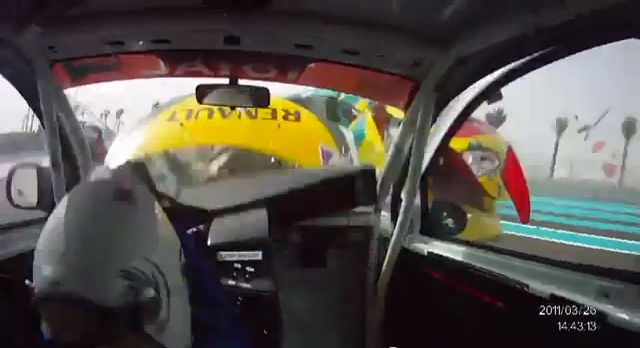
We posted this scary clip found by our friend Sergini, on the Axis Facebook page where it stirred up quite a bit of thoughts and observations. Let's see how it does here.
I would start with a well done to the driver (Youssef Bassil?), for staying cool enough after such a nasty hit to get out the passenger side door after finding the left one jammed. It's a good idea to practice getting out of the car in a hurry, an to have a plan B.
That the driver's side door jammed is a pretty horrid, perhaps the cage failed, who knows. Personally, I don't like to see bolts anywhere on a race car cage.
Another issue brought up was the use, or lack of, a left side retaining net as is common in the US. In this case, it was a good thing it was not used.
HANS very likely saved a life here.
The car is likely a Renault Clio 197 and from the dynamic of the crash I would say it does not have ABS, should ABS be required in some of these lower series?
Discuss
Subscribe to:
Posts (Atom)