Showing posts with label Motorsport Safety Foundation. Show all posts

June 5, 2015

Survey: Virtual Safety Cars in real world racing.

1 comment:
(Getty Images)


The issue of a race car hitting a safety vehicle has raised its ugly head again and with it,  question of a more widespread use of  a Virtual Safety Car.

In the very closing stages of the IMSA / United Sports Car  race in Detroit,  the TRG-Aston Martin Racing 007 driven by James Davison crashed into a safety truck which had pulled out on track to attend to another car which had just gone into the barrier.


Fox Sport's coverage of the incident was pretty lousy but we spoke with out friend,  current Pirelli World Challenge GTA championship leader and MOMO boss Henrique Cisneros, who was trackside.

Cisneros confirmed it had started to rain lightly on the penultimate lap but, as the leaders were making their way through for the final time, it started pouring.  
The Brumos Porsche slid off into the tires in the first corner of the last lap  but the 23 Porsche of Mario Farnbacher and the 007 of Davison were still racing for position when the safety vehicle was deployed on the still hot track.

A local yellow was being waved at start finish which meant drivers could race all the way to that yellow.

It's not an isolated incident,  at the Pirelli Challenge race in Bowmanville Ontario, this happened


There are some obvious questions:

Why no full course yellow (double yellow) with the conditions or/and a vehicle on track?

The track was wetter where the incident occurred than further away, all drivers were on slicks, pits were closed.   Organizers were aware of this, did they feel pressure to not end the race under caution?

Why did the Aston driver not slow down?

If the yellow at start finish was the first yellow he encountered, by the rules, he was entitled to race all the way to that station.  Perhaps he was warned by his crew about conditions but it was the final lap and a pass for the win was possible.

Was there enough time for Race Control to react and would a Virtual Safety Car had been a solution?

As you know the concept of a Virtual Safety Car was introduced in WEC last year and adopted by F1 this season as a response to Jules Bianchi's accident in Japan in 2014, one very similar to this one in its dynamic.   An expansion of WEC's "Code 60" zones, it essentially freezes competitors in their current positions and separations as they they continue to make their way around the circuit at reduced speeds.

An advantages of a VSC over a traditional Safety Car, or even a full course yellow, is that it's faster to deploy and takes options away from drivers who cannot rush to close a gap.
Drivers leading the race like it because it allows for  clean up yet maintains their track position.   Obviously those in the back don't like it for the opposite reason but it certainly is a good toolfor race control to have in situations where everything needs to be slowed down quickly.

Should VSC be introduced in more series?  Is it a good system and could VSC take the place of a physical one or should, as per F1 rules,  a Safety Car always be used the moment any rescue vehicle is on track.
A Safety Car can reboot a race making it  potentially more entertaining,  should a VSC period always be followed by a SC picking up the leaders and bunching the field?

As always we welcome your comment as will the Motorsport Safety Foundation who have launched a survey on the subject I encourage you to fill out.


May 26, 2015

WRC leaves injured driver stranded for over three hours. Unacceptable.

10 comments:

There is no excuse, in 2015, during an FIA sanctioned major motorsport event, for an injured driver to wait three hours and twenty minutes for medical attention, none.

Flickr Photo
Lorenzo Bertelli  may be the scion of one of the worlds largest fashion fortunes, Prada but he's mostly interested in hooning rally cars.  

His team, Fnckmatiè ( the U is upside down), after moving through the junior ranks  is competing in the full WRC  with a Ford Fiesta this season.  
This past week end he was competing in Portugal, the 5th leg of the Championship.


It's the nature of rallies that medical intervention will take longer than on circuits so cars are equipped with electronic signaling devices that can be used to either confirm no serious injury or request immediate medical attention.  

Bertelli and his co driver Bernacchini crashed  just 5 km from the start of the 37 km SS10.  After initially feeling ok, Bertelli developed symptoms of a head injury after a few minutes and his crew mate called for help.


The WRC, organizers in Portugal and the FIA should be shamed into an explanation as to why it took  almost three and half hours to give an injured driver medical attention.

Perhaps Monsieur Todt is too busy jetting around promoting  seatbelt use in Nepal to pay attention?

After he reached the hospital, Bertelli was kept under observation and subsequent exams were negative for major injuries.  He promises to be back for Rally Italy.

Read Fnckmatie World Rally Team's statement for yourself.


February 12, 2015

Animals and race tracks don't mix, revisited.

No comments:

It's never popular when you criticize track safety, people got mad when we pointed out shocking safety lapses at Le Mans for example and people got upset when, at the start of the Bathurst 12 Hr,  I pointed out on twitter that there is no excuse for animals crossing a race track.

In fact, there are a couple other seemingly obvious yet easily improvable safety issues at Mount Panorama, the unprotected concrete walls at the top of the course screaming for some Tecpro barriers come to mind but, lets just stick to animals.

All too often, criticism of safety is met with a refrains along the lines of "that's the way it is, you can't do anything about it" and "racing is supposed to be dangerous".

Bathurst 12 hour organizers have been trying to do  something about the kangaroo issue.   Last year they proposed culling the skippies but that met with the displeasure of animal lovers and those who think 180 pound marsupials are a quaint feature of the Mount Panorama circuit.  Safe to say most of those complaining are not racers.

This year's plan involved snipers,  because involving high powered rifles on a circuit where fans strategically  bury beer  to circumvent a 24 per person limit, well,  what could possibly go wrong?

Most tracks have fencing.  A novel idea, I know and one that is usually unpopular with organizers because it costs money.    Curiously though organizers are usually not shy about fences when it comes to keeping non paying fans from getting a glimpse of the action.

Fences have the added advantage of keeping cars out of the woods and any flying bits out of the spectator stands and it's fair to the kangaroos.

I'm going to go out on a limb and say Anthony Gilbertson is in the "build a fence camp" after smashing into a kangaroo at 220 km/h. with his BMW in the opening phases of this year's Bathurst 12 Hour.

It's not pretty,

(hat tip to Dominic Carey for finding the clip)

September 19, 2014

The importance of proper barriers.

5 comments:


The team behind Circuit of the Americas did a stellar job building a world class facility, the only FIA F1 Certified track in the United States.

FIA certification means a very high level of safety incorporating all the latest advances in the field But, to all those who still insist safety equates to less excitement, let me show you how all that work paid off today.  

I would bet you Tim Bell, the Nissan 370Z driver racing in the Continental Tire Sports Car Challenge series,  did not find it boring at all.


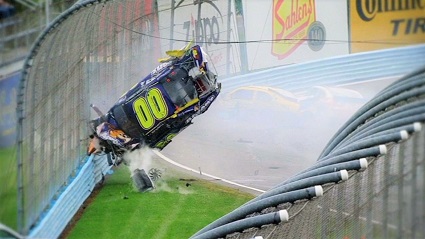
In this case,  the paved runoff made things worse but the FIA barriers did a superb job absorbing the impact. Contrast this to the recent crash at Watkins Glen.

A stack of tires, bare armco, just don't not cut it anymore and it's really up to all of us racers and enthusiasts to demand every track make the effort to upgrade.   This is why Axis is fully behind efforts of the Motorsport-Safety Foundation and the Sean Edwards Foundation.

We're guessing Tim Bell will be too.


July 15, 2014

A former F1 doctor speaks.

2 comments:


Gary Hartstein, the badass, cigar smoking doctor who was Formula One's Medical Delegate from 2005 to 2012,  has been very much  in the public eye in the first half of this year because of his frank, sometimes brutal, comments about Michael Schumacher's medical outlook after his skiing accident.

His articles on the subject were a respite from the tidal wave of non scientific drivel and misinformation printed about Schumacher and head injuries in both the mainstream media and in the tabloids.

Hartstein eventually got a quite a bit of flack for it, very unfairly in our opinion, mostly from those for whom the grim reality of scientific data did not fit a wish of a happy ending scenario for the German champion.

The Doc finally became fed up of being misquoted and stopped discussing it.  But all that needed to be said, was.

This interview, part of the same ShakeFree series as the Derek Warwick clip you saw recently, was shot before that all happened.

Along with remembrances of Professor Watkins and speculations about what led to his dismissal by Jean Todt,  there is a section where Hartstein talks about how F1, thanks to the application of scientific method has, since 1994, become very low on the list of dangerous sports.
No small irony ironic that one of its greatest champions, after twenty years in the sport,  was so injured in a mundane activity.

Hartstein also makes the point that safety is never perfect and that while top tear single seater racing in now very safe, the greatest dangers lie in the minor formulas,  semi pro, amateur and club racing.    

We wonder if the doctor might be interested in the work of the Motorsport Safety Foundation,  there is much more room for safety improvements and big returns on investments at the bottom end of the sport.

So light up a stogie and listen to this  Former F1 Doc

(thanks to Mario Muth and ShakeFree)


June 16, 2014

Oh Oh....

2 comments:


Here's is the video from Pete's off at Road Atlanta we had told you about over the week end.  He was too optimistic with his turn in speed into turn one, almost saved it.  Data showed he hit at 56 mph.

Pete was unhurt.

Overnight frame straightening, $525.
Two e30 fenders: maybe a couple hundred in a pinch.
Good safety features at a race track:  Priceless.

nRelate Posts Only