Showing posts with label Mark Hales. Show all posts

January 23, 2013

Mark Hales Invitational Trophy

10 comments:

Shit happens, at the track more so than elsewhere.  Maybe Hales gambled and lost but don't any of you tracktards reading this lie and say if had the same opportunity you would not have taken it.  

Certainly you have enjoyed his work so I say: let's help the man out, every little bit can help and if the response is overwhelming, the excess goes to charity.

We for one want to live vicariously sliding sideways at Goodwood in a priceless 250 GTO this fall!

Track Driver Magazine is doing all the work:

"During 2009 Mark Hales was driving a Porsche 917 belonging to David Piper for a feature with a Ferrari 512S owned by Nick Mason. This was for publication in Octane and Auto Italia magazines.

The engine failed due to an over-rev caused by a missed gear, and while Mark maintained there was a wrongly adjusted gearshift which he raised prior to failure, Piper maintained all was well. Similarly Mark maintained there was a verbal conversation surrounding liability in the event of mechanical failure not covered by the insurance, Piper maintained this conversation didn’t take place. Having then failed to obtain remedy from Octane magazine and their insurers he then sued Mark personally in the high court.

Any claim is highly unusual in the world of classic car racing and there are implications for both those driving other peoples cars, and the motoring press in general. This is well described by Motorsport Magazine's Andrew Frankel below;

http://www.motorsportmagazine.com/miscellaneous/mark-hales-found-liable-in-piper-case/

The judgement went against Mark and he has now to settle the entire judgement of over £120,000.

The claimants lawyers have stated their intention to issue an interim demand for £35,000 which has to be paid in 14 days’ time.

Mark does not have the means to settle the judgement and now faces bankruptcy. The industry has pulled together to avert this and discussions are underway for events that you can support. In the meantime this Paypal account has been set up to assist Mark in relation to the adverse judgement.

Funds credited to the account are gifts, with any surplus being paid to Mission Motorsport – The forces charity headed up by Jim Cameron. While negotiations are underway, Mark is currently dealing with a judgement in excess of £120,000. The claimants lawyers have stated their intention by issuing an interim demand for £35,000 which has to be paid within 14 days of the judgment.

A personal message from Mark follows;
I’ve thought long and hard about this as you can imagine. I feel the decision against me was unjust and I can’t help but come to the conclusion the judge had made his mind up before the case began.

The lawyers have advised that an appeal is legally possible, but this has been an emotionally upsetting time and after four years the prospect of another two spent in similar fashion are not welcome and I would like to bring an end as far as I am able. Unless some significant new evidence comes to light, I do not intend to pursue this further.

I am a racing driver and journalist not a lawyer, and I would like to get back to what I do best.

Thank you all for your support both on line and directly, it’s very welcome and comes at a difficult time.

Mark"

January 22, 2013

Who pays for damage to a race car?

7 comments:


Over the week end an article popped up on Twitter telling the story of the dispute between 1960's race driver David Piper and motoring journalist/author/classic car racer Mark Hales.  

Piper has sued and won judgement against Hales for the cost of an engine rebuild on a replica Porsche 917 he had lent the journalist for a magazine article in 2009.    Boiled down to Hales maintaining there was a problem with the gearbox,  Piper saying Hales "money shifted" the air cooled 12 blowing it up.

If you follow classic car racing you will have seen Hales drive some of the world's rarest and most precious cars.   If you have ever seen a Goodwood Revival, it's pretty clear many owners of these rolling treasures appreciate the very real risk that they will get bent.  Certainly they understand, as anyone who has run cars on track, that every part of a car is a consumable destined for replacement or rebuild.  But mistakes can an do happen.


In a modern race car this would not have been an issue,  a perfect example at last year's 24 Hour of Daytona our friend Spencer Cox had the engine let go in practice on a TRG Porsche GT3.   Porsche engineers plugged in a computer and in less than an hour determined it was their fault and rolled in a crate with a new lump.    Montreal GP this past year, CG was racing Ferrari Challenge, tearing through the field when he lost 3rd gear.   Later that day data was sent to Maranello and Ferrari covered the gearbox under warranty (much to CG's relief, I'm sure).  

The issue with older cars is murkier.  I was surprised to read a complete engine rebuild for a Porsche 917 is "only" $58000 and considering Mr. Piper owns the cars in the clip below amongst other things,  it seems bad sport to go after Hales like that.  One wonders if there was more to it and in fact, if you read the judgment motivations,  it does not look so good for Hales who was less than clear in giving evidence and seems to have made some ill advised statements.


This morning reading Pistonheads I saw Chris Harris has written about the case, exploring it from the working journalist angle.  Not surprisingly he's very much in Mr. Hales' camp.

This particular case did not involve racing, just a photo shoot apparently but I'm curious about how you approach the subject of lending yours or driving someone else's car in a track situation.  
What about endurance racing, if you are part of a team and one of the drivers has a problem,  how have you dealt with a mechanical issue?   How about if the car gets hit though no fault of the driver, or if a driver goes off in the rain for example?   Discuss!

January 27, 2011

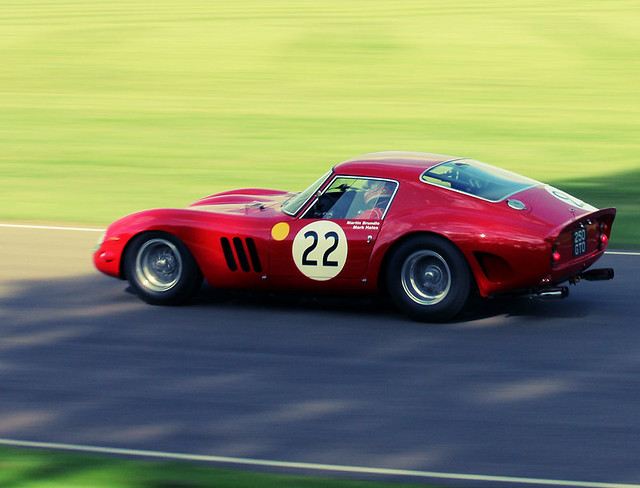
Martin Brundle getting his butt kicked in a 250 GTO.

6 comments:
1962 Ferrari 250 GTO

It's fifteen minutes of bliss even if the first part of this clip consists mainly of new BBC Formula 1 commenter Martin Brundle getting passed left and right at last fall's Goodwood revival. He's short shifting, he's missing gears, but who would not be nervous racing a car worth about $20 million on a track with mostly grass runoff?

Well, Mark Hales, that's who. In the second part of the clip, after the driver change, it's Hales who does the ass kicking, slicing through the traffic, seemingly without fear. Of course Hales is very familiar with this particular GTO and its owner, Nick Mason.

I always recommend Hales' great book Into the Red if you are lucky enough to find one for a reasonable price. Remember to get the version with the CD!

Don't miss the clip after the jump..


(ChaseCam via motorsportblog)


>end of post

January 3, 2010

Sliding Into 2010

3 comments:
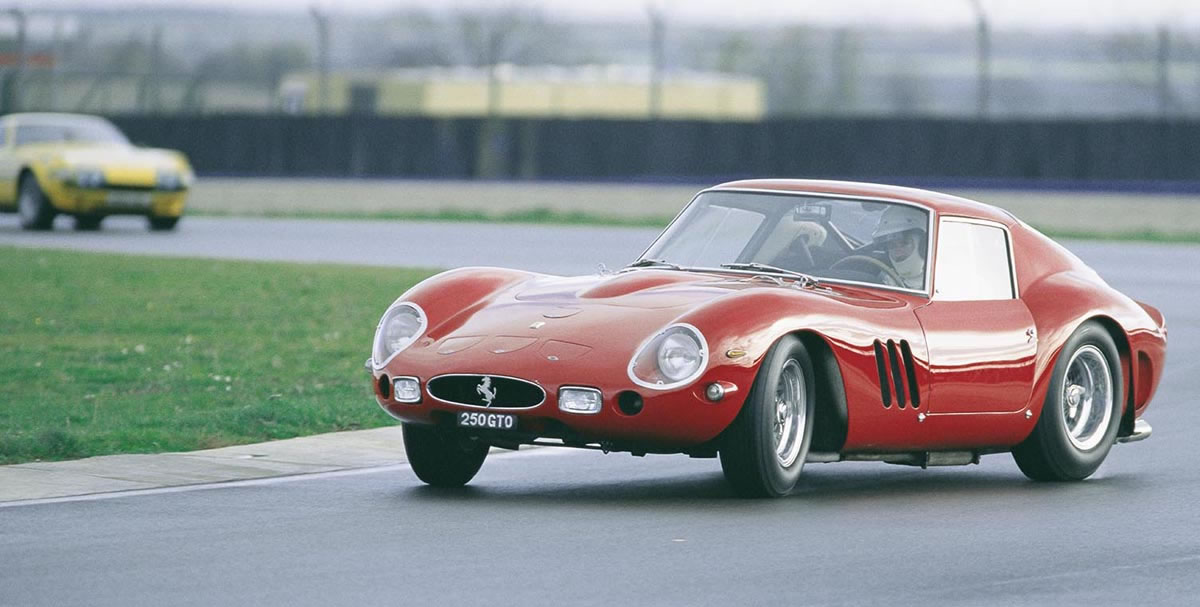
Axis of Oversteer has been quietly on vacation but what better way to break into the new year than to ride along in a Ferrari 250 GTO at Silverstone.

Behold the joys of a 3L v12, cross ply tires and a live axle rear end!

After the jump make sure to read what Mark Hales wrote about this very car, Nick Mason's 1962 Serial Number 3757 which he bought in the late 70's for around $86000, a priced deemed very high at the time.


Below is an excerpt from Mark Hales and Nick Mason's great book "Into The Red". A must have for petrolheads and tracktards. Especially so the UK edition with comes with a CD, recorded to Pink Floyd audio standards of course, featuring the mechanical music of cars in Mason's collection . Save it and play it back on your electric car's stereo and cry.

Click on the photos below for links to the books on Amazon, the Mac-F1 links to the US store and the ERA to the UK/Europe.


If ever a car looked absolutely right in all respects, then it is the Ferrari GTO. The plunging valley between those humpy front wings, the little mouth pouting at the tip of its bonnet, the subtle flip-up on the boot. Never mind that the nose is long and the tail short and never mind that there are vents and slots and flaps everywhere to break up the sculptured smoothness of the body. The car still looks perfectly balanced in every respect. Prise open the flimsy door with its little handle - which, like most of the minor fittings, looks ready to snap off in the hand rather than trip any mechanism - and slide into the clasp of a welcoming bucket seat whose black leather surface has been polished by nearly 35 years of competition.

Two things immediately demand your attention inside. The gear lever, which sticks up like some mystic sword from a transmission tunnel high enough to rest your elbow on, sports a polished aluminium knob the size of a tennis ball. In neutral, it lies at exactly the same height as the steering wheel's centre. From its centre, spokes polished bright enough to dazzle support a thin wooden rim and if you simply let go of this and keep the arms bent, your hand falls instantly to the gear knob. It's more than natural. Further down and just to the left of the gate which guides the metal mast beneath your shifting hand, there's a huge speedometer in a plastic-covered cardboard box. Only road legality demands its presence; the all-important rev counter with its wide plastic needle and bold but pale white numbers is dead ahead in the main instrument panel.


Already you feel comfortable at the controls, arms and legs bent in best laid-back foetal style, hands on that spindly wheelrim, legs resting on thoughtfully placed leather-covered pads designed to save the limbs from bruises throughout 24 hours. But now for the noise, which, like a signature, defines all the cars in this book. First the whirring starter, sounding as if it's turning 10 times faster than it is. Then the chuffing and thumping as the cylinders come alive, hissing and spitting back through the 12 carburettor chokes under the bonnet, then booming and drumming round the big silencer boxes further back beneath the seat. The sound is richly textured, with a host of extra whistles and whines from a multitude of camshaft drives, pumps and belts. Even when it's fully warmed, the GTO's engine never seems really happy at idle or trickling round the paddock. It will, but then you have to give the accelerator a good long prod in order to clear the throat, ready for the real performance. Snick the metal ball across and back for first. Feel the subtle mechanical advantage of a long lever and a short shift action, and ease on to the track.

A few yards and the wheel's wooden rim is already telling you things. A ridge in the road from paddock to track, a touch of camber here, a change of surface there. The effort required to steer is minimal, like any modern power-assisted set-up, but there's no such interference here, nothing to mask the feel of the road. No hydraulics or electronics to damp out the little tremors that tell you the surface is broken, or to hide a gentle change of weight which warns of lessening grip. Just pure communication with the Tarmac. How did they do it? How could they make steering so light without being twirly and low geared; how could they make it so sharp and accurate without being hard to turn? How delicate it all feels through that varnished brown thin wooden rim when compared with the thick black handful found in today's transport.

Now, as the speed picks up, the GTO begins to float rather than drive. Lie back and enjoy the sensation, because there's no effort required. The chassis works in perfect harmony with the steering, as if the whole car is articulating from a point just under your seat. The wheel tells you what to do and you adjust the car's attitude rather than steer it through the corner. It doesn't need to slip its tail or push its nose wide because you felt it coming and made the correction almost before it was necessary. It's like telepathy. If ever there was a car to recapture those glorious Sixties images of Hawthorn or Moss drifting round Goodwood, the nose of the car angled to the track, but with no steering lock one way or the other, then the GTO is it.
The engine is now well and truly awake, its throat clear and its voice in perfect tune. The downmarket steam-engine noises and raggedy beat have been replaced by a rich tenor, swelling from under the bonnet as the revs rise like a chord from a pipe organ. Outside, the four exhaust tailpipes add just a touch of rasping trombone. It's a noise only Ferraris seem able to orchestrate.

A perfect car then. Well, perhaps not quite. A few laps of Silverstone's super-smooth and grippy surface make the Ferrari's three-decade-old brakes grumble and grind while the middle pedal edges ever nearer the floor. The gears, too, will fight back in the face of a hurried shift. The action remains a delight, but timing is essential – too fast and the grating from within jars the palm outstretched round that huge bauble of a gear knob; too slow and the engine comes jerking up from near idle speed to take up the drive again. Get it right and the flow of acceleration and the seamless step down the musical scale will serenade your success, but it takes practice. And once away from the seductive ergonomics of the GTO's cockpit and the balance of its chassis and steering, you realise that the steering is light because the grip from the tyres is fairly low. The tall Dunlops are about the same width as those on an average modern hatchback, but you hadn't noticed because the car's beautiful balance allowed you to carry so much extra speed into and throughout the turns.

The GTO was another favourite, because if its elegant looks and natural cockpit layout, because of its beautiful balance of steering and chassis and because of the richness of its 12-cylinder soundtrack. It was another fusion of artistry and purpose that progress would sacrifice to the grip of bigger tyres and the downward pressure of aerodynamic development.

* This feature, one of several extracts from Into the Red, by Nick Mason and Mark Hales (Virgin, ISBN 1-85227-717-3), was first published in the Telegraph Motoring section in September 1998. An expanded edition of the book, featuring more cars and audio recordings, is in production now and will be published next year.

nRelate Posts Only