Showing posts with label How to Drive FASTER. Show all posts

June 4, 2014

How to Ricky Bobby a 458 Challenge around the Circuit Gilles Villeneuve.

2 comments:

Set aside for a moment that this report was redacted by one 'Mike Honcho",   there's a lot of great information from the team coach in this handout CG got before his first Ferrari Challenge race in Montreal, two years ago.   (Names of the drivers have been redacted to protect the innocent...)

All data geeks and driver coaches will love this!


October 12, 2013

Speed Secrets Saturday: Fast Turns

2 comments:

This being Suzuka and  Bathurst 1000 week end, its seems appropriate to discuss fast turns.  What would you be thinking barreling down towards a turn like say, 130 R?  I would think  Ross' advice about breathing would be invaluable.
Bart Huiziga

The Approach to Fast Turns

The big, fast and hairy turns are often the ones that separate the men from the boys, right? Sorry, and also the women from the girls.

Most often, it’s the fast turns where you stand to gain the most in terms of lap time. So, what do we do with the fast turns? We try to drive them as fast as we can. And when we rush into them, we hold our breath, tense up, lift off the throttle just as we turn in, changing the balance of the car, and reducing its overall level of traction – right when we need all we can get.

October 5, 2013

Speed Secrets Saturday: Getting Up To Speed Quickly

No comments:
Photos: Roberto Blank?Flickr


Autocross can be good training for this, when you have only three runs to get your time in, it will develop your mental an muscle memory to get you ready to go...from the get go .


Getting Up to Speed Quickly.


Some drivers seem to get up to speed within a lap or two, while others seem to take forever. It’s like they need lap after lap to get into the rhythm before they start turning quick times. If you’re slow to get up to speed, you know all too well the problem with that – losing out on part of each session, and not getting in as much practice time as others.

Your mindset, or your state of mind can affect your ability to get up to speed quickly. If you're too intense or wound up, it may take a number of laps to settle down and get into your rhythm; if you're too relaxed, it may be the opposite. You need to find the ideal performance state of mind to trigger your ability to get up to speed quickly.


Think back to times when you did get up to speed quickly, or at least went a little quicker than other attempts. What was your state of mind at that time? Were you relaxed and calm, or energized and intense? Be aware of your state of mind prior to each session on track. Note what it was like when you got up to speed quickly and performed well. Then trigger that state of mind again by replaying how it felt, and the experience.

If you need to relax more, give yourself some time just prior to each session to sit, breathe, feel your muscles letting go and relaxing into your chair, visualize a very calm scene, and see yourself feeling relaxed in the car.

If you need to raise your intensity level, try physically moving - get your blood flowing - by doing some fast “cross crawls,” riding a bicycle, or even just running in place. You can try some shadow boxing, and even yelling. Use your physical state to trigger your mental state.

Then, think fast-fast. Use that as a "trigger" for the future. The more you do this, the more you'll program yourself, and eventually it will become your norm and you'll be known as one of those drivers who gets up to speed quickly. You'll be the fast-fast one.

Ross Bentley
For more of Ross' writing, along with articles by other famous and not-so-famous contributors, go to www.speedsecretsweekly.com. He can be reached at ross@speedsecretsweekly.com.


September 21, 2013

Speed Secret Saturday: Debriefing.

1 comment:
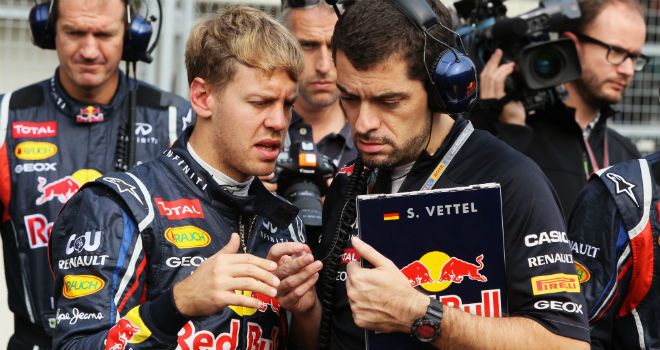
Sebastian Vettel and "Rocky" Rocquelin


Communicating with your race engineers (even if that engineer is yourself) is crucial and this week Ross Bentley has a handy, prioritized list of for you to follow.


Handling Debrief Process


Alonso and Andrea Stella
Whether you have a team of engineers working on your car, or you discuss your car's handling problems while looking in a mirror each and every time you come off the track, you should consider what setup changes you could make to your car.

Of course, your answer may be, "Nothing," since you may have decided (smartly) that you're not going to make changes to your car until you know for sure that you've gotten most everything out of your own driving.
Still, I think a good habit to get into at the end of each on-track session is to ask yourself, "If I could make the car do one thing better, what would it be?"
Kimi debriefing
In doing so, you may uncover a driving issue or technique you want to improve before making changes to your car, but you might also discover a critical handling issue.

Having asked yourself that one all-important question, I then recommend the following process for debriefing on your car's handling (again, you can use this to debrief with yourself if you're your own "engineer").

Ask yourself these questions, in this order:

  1. What is the car doing? Understeer, oversteer or neutral?
  2. Where is the car doing it? Which turn(s)?
  3. Where in the turn(s)? Entry, mid or exit?
  4. What am I doing when the car does this?
  5. Braking? 
  6. Trail braking? 
  7. Releasing brakes? 
  8. Coasting? 
  9. Maintenance throttle? 
  10. On power? 
  11. Slowly turning steering wheel? 
  12. Crisply turning steering wheel? 
  13. Steady steering? 
  14. Unwinding the steering wheel?
  15. Is it the car or me? Am I inducing the handling problem, or is it the car?

If you follow the process of asking these questions, in this order, I'll guarantee you'll learn something that'll make you and your car faster. If you answer these questions honestly, digging deep for the answers, what to do setup-wise (or with your driving technique) will become obvious.

Ross Bentley
For more of Ross' writing, along with articles by other famous and not-so-famous contributors, go to www.speedsecretsweekly.com. He can be reached at ross@speedsecretsweekly.com.

September 14, 2013

Speed Secrets Saturday: Managing Mistakes

2 comments:
I feel that all too often, instruction at track days is an exercise in making students terrified about making mistakes,  deviating from "the line" or "the way" of doing things.    
Granted, instructor self preservation plays a part and basics do have to be learned but, at a certain point, as a driver you need to realize turning in early does not automatically mean you will crash in a ball of fire.
In fact, mistakes are an integral part of learning and if you do things always the same way, you will not improve.
Managing your mistakes is the theme of this week's SSS with driver coach guru Ross Bentley.

Photo: Jamey Price


Managing Mistakes

Making mistakes is one of the most natural and human things we do. Accept it. In fact, the more you try to resist making mistakes, the more likely it will be that you’ll make them. Instead, accept that you're going to make mistakes, but focus on minimizing their effects and on learning from them instead. Mistakes are really "learning-takes."

August 31, 2013

Speed Secrets Saturday: Practice Strategically

No comments:
Photo: xynamic.com


Driving fast is not one skill, it's orchestral multi-tasking at speed.  Want to be as badass under brakes as Alex Buncombe?   Ross recommends practicing each part individually before playing the full tune.  


August 17, 2013

Speed Secrets Saturday: Look at Nothing.

2 comments:
Keep in mind these are exercises meant to tune your on track ability and certainly do not take Master Ross's column this week as an encouragement to look at your smart phone while driving.   
Quite the opposite, the exercise is about your ability to think ahead,  see beyond the obvious and be aware of how you can use empty space.  Understand, grasshopper?


Look At Nothing

I've written in the past about the bad habits drivers develop on the street, so this one is about what to practice - and make into a good habit - on the street.

How many times have you heard the advice, "Look where you want to go"? A lot, I’ll bet. Great advice. But if you don't practice it and make it into a habit or a mental program you won't use it when you need it most... when a car is spinning in front of you on the track.

On the street, practice looking at nothing. Look for the opening, whether it's a gap in traffic, a parking stall, the area between reflectors on the highway, or whatever. As humans, our vision is attracted to things - any things, especially bright shiny objects like other cars. We spend so much time driving in traffic, looking at other vehicles that we build a habit of looking at them. And as you know, we go where we look. So, when a car spins in front of us on the track we look at it, and we can't help but steer towards it.

Consciously and deliberately, while driving on the street over the next month, look at nothing, look at the gaps between traffic, at the openings. Put a sticky note on your dash or steering wheel to remind yourself: "Look at nothing." Build a habit of looking for the opening.

Ross Bentley


For more of Ross' writing, along with articles by other famous and not-so-famous contributors, go to www.speedsecretsweekly.com. He can be reached at ross@speedsecretsweekly.com.


August 10, 2013

Speed Secrets Saturday: Listen Up!

4 comments:

Driver coach guru Ross Bentley says: your ears make you faster! The importance of using all available feedback.
Be sure to check all driver tips on Axis and subscribe to Speed Secrets Weekly for great insights from Ross' team of top go-fast coaches.


Listen Up!

What senses do you rely on when driving on a track? Vision is obvious - you look where you're going. Feel, or what really should be referred to as kinesthetic (because it includes feel or touch, plus balance and the ability to sense g-forces) is also critical. And of course, your hearing, or auditory sense. Smell is typically used only to sense problems. I hope you're not using taste while driving on the track!

Which sense is most important? Could you drive if you were deaf? Yes, but it would be more difficult, wouldn't it? Could you drive on a track if you had no kinesthetic feedback? Actually, that's no different than using most computer games or simulators - they provide visual and auditory feedback, but not feel. So you can drive without kinesthetic feedback, but it's more difficult. Could you drive on a track if you were blind? Yep, but for a very, very short distance!!

It seems, then, that your vision is the most important, and possibly kinesthetic is second most important. I think that we use vision to get us around the track (it's the "where we go" sense), but it's kinesthetic that makes us fast (the "feel the limit" sense).

But get this: Our ears and auditory cortex can process a signal forty milliseconds faster than our eyes and visual cortex. So, when the car steps out and begins to slide, our visual picture has changed and we react, but perhaps it's the change in sound that we react to first. Interestingly, touch/feel (kinesthetic) is the slowest sense we have. Hmmm... makes you think about how we really sense the limits of the car, doesn't it?

Think about this the next time you're at the track. Protect your hearing. I said, protect your hearing! I said, PROTECT YOUR HEARING! You may think that standing around a track, especially if there are only street cars being driven, won't impact your hearing. Over time, it will - unless you protect your hearing.

And take time to drive just listening to the car's engine sound, the wind passing by, the transmission sounds, feedback from the brakes, and the tire noise. The car is talking to you. Are you listening? You may be surprised just how much better you drive if you focus on what you hear.

Ross Bentley
For more of Ross' writing, along with articles by other famous and not-so-famous contributors, go to www.speedsecretsweekly.com. He can be reached at ross@speedsecretsweekly.com.

August 3, 2013

Speed Secrets Saturday: Turn in Early with Big Speed!

1 comment:


This week Ross illustrates strategies to achieve one of the Axis' favorite mottos, as coined by the great Spencer Pumpelly,  the secret to a fast lap? "Turn in early with big speed"!

You can catch first three episodes of Speed Secrets Saturday, HERE.   If you would like more tips like these delivered to your inbox, subscribe to Speed Secrets Weekly!

Corner Entry Speed

Corner exit speed is critical, right? It’s all about who can begin accelerating out of the turns first – that’s who’s going to win, right?
But, wait a minute. Corner entry speed is just about as important. In fact, I'd argue that it's the area in which most drivers can make the biggest improvement in their lap times. If you can increase your corner entry speed, yet not hurt your exit speed, that would be a good thing. So, let's look at how to gain time early in the corners.

There are at least four ways to improve your corner entry speed:

Brake later, compressing the brake zone (starting later, but ending your braking where you always have).
Brake lighter (start braking where you usually do, but just use a little lighter pedal pressure).
Move the entire brake zone further into the turn - start braking later, and finish later.
Release the brakes sooner (finish sooner).

Which is the right approach? I don't know. It depends on the corner, your car, the conditions, and even your driving style.

Most drivers only use the first option, when the other three are often a better approach. Think about it, and try a different method next time on track. Ultimately, your brake release (timing and rate of release) will have the biggest impact on the speed you're able to carry into a turn.

You may find that you’re able to increase your corner entry speed without it hurting your exit speed. In fact, sometimes just a little bit more entry speed actually allows you to begin accelerating even earlier, as it reduces the “change in speed.” But that’s a topic for another day…

Ross Bentley

For more of Ross' writing, along with articles by other famous and not-so-famous contributors, go to www.speedsecretsweekly.com. He can be reached at ross@speedsecretsweekly.com.


July 27, 2013

Speed Secrets Saturday: When Oversteer is Understeer.

2 comments:
The third in the Speed Secrets Saturday series by Ross Bentley. This week the theme is handling: sometimes it's not the setup, it's you.  
Be sure to check out  Part I: Rain and  Part II: Braking.

The Dreaded Understeer-Oversteer Problem by Ross Bentley

"The car understeers early in the corner, then snaps to oversteer at the exit."

That's a common complaint from track day and race drivers. Most often, the priority becomes fixing the exit oversteer because it's "scarier." But the only car problem is the understeer.

Photo: Andrea Cairone/Axis of Oversteer
See, when the driver experiences understeer, the natural instinct is to turn the wheel more - it's human nature. When steering input increases, the car scrubs off speed until the front tires hook up and gain traction, sending the car immediately towards the inside of the turn... and the car oversteers.

So, the understeer is a car problem, and the oversteer was caused by the driver. Fix the understeer and the oversteer goes away. That's why it's important for the driver to be aware of what he/she is doing with the controls when the handling problem occurs.

Mark Hales
The next time you experience the understeer-oversteer problem (and you will if you drive on a track enough), stop and ask yourself what you're doing with the steering wheel when the understeer begins. If you're like most drivers, at first you won't believe that you're turning the steering wheel too much. But if you really think about it, you may realize you are what's causing the oversteer.

Of course, the best thing you can possibly do is spend time on a skid pad training yourself not to add more steering when your car understeers.
It’s easy to say, and even easier for me to write, “When you experience understeer, reduce your steering angle.” But I know from experience, that it’s not easy to actually straighten the steering when you sense you’re on an ever-increasing radius, no matter how good a driver you are. And that’s why practice time on a skid pad is so valuable (not to mention that it’s an absolute blast!).

Be aware of what you're doing with the controls any time the car is doing something you don't want it to do; you may learn that it's not completely the car's fault.

For more of Ross' writing, along with articles by other famous and not-so-famous contributors, go to www.speedsecretsweekly.com. He can be reached at ross@speedsecretsweekly.com.

July 20, 2013

Speed Secrets Saturday: Braking

3 comments:
Photo: Brando Cairone


Part II of Speed Secrets Saturday, driving coach guru Ross Bentley insights for you on Axis!
This week, getting rid of bad braking habits resulting from driving like... well, like a normal person (New Yorkers may have a built in advantage here).

Like it and want more?  Sign up for Speed Secrets Weekly and have coaching tips from some of the best coaches delivered straight to your inbox!


Stop Driving On The Street by Ross Bentley


Where do you spend the bulk of your time driving? On the street or on the track? Unfortunately, it’s on the street, right? And that's the problem with many track drivers' braking - the habits they’ve built while driving on the street.

Photo: James Boone
When you brake to a stop at a traffic light, how do you apply the pressure? You probably squeeze the brakes, gently increasing the pedal pressure the closer you get to where you want to stop, before finally easing off just as your car stops moving. 
So your brake pedal pressure starts relatively gently and then increases to its maximum near the end of the "brake zone." 

That's the opposite of how you should brake on the track.

Photo: Marcel Tauch
On the track, you want your initial braking application to be relatively hard, getting to maximum pedal pressure as quickly as possible. Then you want to maintain that pressure until you begin to release the pedal as you reach the turn-in point. So the pedal pressure goes from immediate maximum pressure to gently trailing off the pedal as you get to the end of the brake zone. 

Yep, the opposite of how you brake on the street.

Photo: Dennis Noten
You’ve probably been given the advice to squeeze the brake pedal on, to be smooth. Hey, I wrote that in my Speed Secrets books! But in some ways I regret it. 
Why? Because many drivers have taken this too literally – they’re too smooth with the initial application of the brakes. What I meant was to squeeze the brake pedal, but to do it really, really fast, ramping up to full pressure as immediately as possible. 
Applying hard initial pressure to the brake pedal can be done smoothly. But it might be a little more abrupt than you’re used to because of the way you drive on the street.

When I get to take someone for a ride around a race track – even an experienced track day driver or club racer – the comments afterward are predictable. “You’re very smooth! Well, except for when you first hit the brakes. I was surprised at how hard you braked – and how late.”

So if you want to be faster on the track, change the way you drive on the street to develop the habit of braking the right way. Sure, that might be a little harsh on your passengers, but you'll be giving them something to cheer about when they come watch you race. :)

For more of Ross' writing, along with articles by other famous and not-so-famous contributors, go to www.speedsecretsweekly.com. He can be reached at ross@speedsecretsweekly.com.


July 13, 2013

Speed Secrets Saturday: Rain.

3 comments:

One of the great pleasures of publishing Axis of Oversteer has been the chance to meet some of you readers, even if just virtually.  I'm always amazed to  to find out who stops by here  and  I take it as a personal badge of honor to count Ross Bentley among them.

Ross needs no introduction to many of you who have read his Speed Secrets series of books, required reading for anyone who loves doing what we do with cars.   To supplement the book series Bentley has recently started a subscription newsletter, SPEED SECRETS WEEKLY,  which will deliver articles penned by him and his extensive gang of some of the top driver coaches around, directly to your inbox.  Sweet, please check it out.

To give you a taste of the kind of valuable content you can access there, Bentley has agreed to write a series of articles for a new Axis series: Speed Secrets Saturday.  

The first piece is about driving in the rain and along with Ross, my thanks go to another great Axis friend, Jamey Price who has gone through his archive and choose these fantastic wet racing shots.
For another take on driving in the rain, have a look at "How I stopped worrying and learned to drive in the rain"


Racing In The Rain: Lessons from Enzo by Ross Bentley

Racing in the rain. Drivers either love it or hate it. There are very few drivers that have a “take it or leave it” attitude towards splashing around a race track. And drivers that hate the rain think that drivers that love it are either weird or stupid – or both.

I love racing in the rain.

That means that, depending on how you feel about wet race tracks, I now know what you think of me. But that’s okay, as long as you don’t get in my way as I slip and slide my way around. Don’t get in the way of my fun, please.

To borrow a line or two from my friend, Garth Stein, author of the best-selling novel The Art of Racing in the Rain, “I know this much about racing in the rain. I know it is about balance. It is about anticipation and patience... [it is also] about the mind! It is about owning one's body... It is about believing that you are not you; you are everything. And everything is you.”

Hmmm… What does Garth know that will make you faster in the rain? Actually, if you’ve read The Art of Racing in the Rain, you know that it’s Enzo, the dog, who says this. And after many years of studying racing, he knows best. In fact, if he had had opposable thumbs, he’d have proven his point by getting behind the wheel himself. Bark, bark.

Having spent some time coaching Enzo… err, Garth, let me share with you a few of my favorite Speed Secrets for racing in the rain – or just quickly navigating your way around a wet circuit in any kind of driving event.

1. Initiate slowly, react quickly.
All of your inputs must be made as slowly, gently and smoothly as you possibly can make them. That includes your steering, throttle and braking movements. Did you notice I didn’t just refer to the brake application? That’s because it’s not just how you apply the brakes, but perhaps even more importantly, how you release them. Same with your steering – your steering output (meaning, how you unwind the steering) is just as important.

So, your goal is to make every deliberate movement of the controls as slowly as possible, as that will make you smoother, increasing overall traction.

But, when it’s time to react to the car sliding, do it quickly. Don’t let the car get too far out of line, otherwise you’ll get “behind in your steering” (as one NASCAR driver said years ago about why he spun out).

2. Make the car do something.
When I played tennis seriously, years ago, I played at my best when I attacked. If I was hesitant, I lost. When I skied moguls, I had to attack them, otherwise I’d get behind and be reactionary rather than being proactive. If I’m hiking down a steep, rocky trail I’ve found it’s best to attack there, as well. If I’m holding back, waiting to avoid slipping, I’m more likely to slip.

When I approach a turn in the rain, I find it best to enter just slightly faster than I think the car can handle, making it slide from the moment I enter the turn. If I don’t – if I enter at a “comfortable speed” – I then spend the rest of the turn waiting, waiting, waiting for the car to start sliding. If it’s doesn’t slide, well, I know that I’m slow; if it slides, it takes me somewhat by surprise. But if I purposely make the car slide from the very second I enter the turn, I know exactly what I have. I know the grip level, and I’m more than ready to deal with the slide.

3. If the car feels like it’s on rails, drive faster.
As I said, if the car is not sliding at all, then I know I’m slow. If I’m not sliding, I know I can increase my speed.

4. Relax your grip and breathe.
The next time you’re driving down the highway, grip the steering wheel as tightly as you can. Then notice how much vibration you sense coming back through the wheel. Next, relax your grip, holding the steering with a light grip, and notice how much more vibration you feel. The lighter your grip on the wheel, the more feedback you get from the car. If you’re having a difficult time sensing the limits of the car in the rain, I suspect you have too tight a grip on the steering wheel.

Relax. Breathe.

When you hold your breath, you tend to tense your arms, hands, and the rest of your body, and therefore reduce your ability to sense the limits of the tires. When you tense your hands and arms, you tend to hold your breath, or at a minimum, restrict it. Which comes first? Holding your breath, leading to tense hands and arms, restricting your ability to sense the limits of the car? Or tensing your hands and arms, leading to restricting breathing? It doesn’t matter. What matters is relaxing your hands and arms, and breathing (or the other way around).

But an even worse thing happens when you hold or restrict your breath: Your brain interprets it as fear and anxiety, and when that happens you kick into fight or flight mode, causing your brains to operate at less than its peak. By “less than its peak,” I mean that it processes information slower, and your vision tends to drop – you don’t look as far ahead. I don’t need to tell you that neither of these are good.

Deliberately practice breathing when driving in the rain. The more you do that, the more automatic it will be, and the more relaxed you’ll be. If you’ve ever seen in-car video of Hans Stuck driving in the rain, you’ll see that he’s playing like a little kid jumping up and down in a mud puddle. Often, he would yodel. Perhaps that was how he ensured he wasn’t holding his breath.


Racing in the rain can be the most fun you’ll ever experience in a car, especially if you keep these four tips in mind. And more important than keeping them in mind, if you deliberately practice them you’ll find yourself “car dancing” in the rain before you know it. If you don’t believe me, just ask Enzo.


Ross Bentley

For more of Ross' writing, along with articles by other famous and not-so-famous contributors, go to www.speedsecretsweekly.com. He can be reached at ross@speedsecretsweekly.com.


October 18, 2012

How to drive FASTER: Road Atlanta

3 comments:


Axis of Oversteer, How to drive FASTER brings you detailed track guides and advice from professional racers aimed at advanced drivers, time trailer and club racers. You can find otherepisodes HERE

Road Atlanta in Braselton Georgia the home of Petit LeMans and another great old school and intimidating track. Built in the 1970s and eventually rescued by Don Panoz, the track was most recently part of the merger deal between ALMS and Grand-Am.

The track is literally in Bimmerworld Racing Seth Thomas's back yard so who better than a Georgia native to give up some of the secrets of the esses?


ROAD ATLANTA

Road Atlanta has always been my home track as I was born and raised 20 miles away. My very first memories of sports car racing are of going to the track  with my dad in the 80’s to watch the glory days of IMSA racing.   I still remember vividly the Camel GTP cars coming through the famed “Dip” and crest the hill at Turn 11 at speeds in excess of 100 MPH, right side mirrors about to touch the wall going under the bridge.
As a young kid I always thought about how cool it would be to drive one of these cars at Road Atlanta.

Fast Forward to 1998 when the opportunity to drive Road Atlanta arrived when I signed up for a Track Day with the BMWCar Club of America.   This was my first event with my new to me 1997 BMW M3.
I was hooked. I started looking for every track event at Road Atlanta I could attend.  Then I started racing in 2001 in a ITB 1984 BMW 318.  This car helped teach me the line around the track.  Since then I have modified the line I started learning at Driver’s Ed events to the one I use to race.  Racing for BimmerWorld in the Speed World Challenge Touring Car helped hone my line around Road Atlanta. Those cars were fast with a small tire with very little grip but the lap times were similar to a Porsche 996 GT3 Cup Car.

For my friends at Axis of Oversteer here is a detailed lap around my home track of Road Atlanta including pictures from inside the 2007 BimmerWorld BWM 325 Touring Car.


Front Straight

A lap at Road Atlanta starts with a fast run through T12 onto the front straight. This straight is not very long but it is fast as the entry speed is around 110-120 MPH. The important part to remember here is to look ahead for the brake markers for Turn 1 and pick them up with your vision as early as possible. The exercise of finding the brake markers as early as possible will help you for the rest of your lap.

Turn 1

Turn1 is a very fast constant radius right hand turn featuring both downhill and uphill changes in elevation. It slopes downward a small amount in the brake zone down to the apex and gains elevation from the apex out. It is important to take note of these changes to maximize grip and speed in all the stages of Turn1.

Heading into the brake zone for T1 the speeds will be around 120-130 MPH. Line the car up with the left side of the track. The importance here is to give yourself as much track surface as you can so you can roll big speed through Turn 1. This is the second biggest brake zone of the track but be careful not to overslow the car. I tend to give the car a big hit of the brakes on initial brake pedal application but roll off the pressure on the pedal fairly early to get the front tires ready to turn in with speed.

As I start to bleed off brake pedal pressure I slowly start to turn the car in a tiny bit early as the track starts to slope downward and the cars starts to slightly understeer. I release the brakes a little early to roll the speed down to the apex. At the apex point is the transition from downhill to uphill and the front starts to gain grip again. This is when I transition my right foot to the throttle pedal and start to aggressively apply throttle. I want to use the grip gained by the uphill run to help the car accelerate out. Once I turn in for Turn 1 I do my best to maintain the same steering input throughout the whole turn. Use the majority of the track but remember to start the setup for Turn 2 on the exit.

September 27, 2012

How to Drive FASTER: Laguna Seca

6 comments:


Axis of Oversteer, How to drive FASTER brings you detailed track guides and advice from professional racers aimed at advanced drivers, time trailer and club racers. You can find otherepisodes HERE

Mazda Raceway at Laguna Seca California. The iconic Corkscrew, how do you drive it like a boss? We asked Grand Am Continental Cup Bimmerworld driver Gregory Liefooghe for some tips.


INTRODUCTION

Living in San Francisco, Infineon Raceway is my home track, I’m working there every week but Laguna is very close to home.

Laguna has a few quirks, some interesting and at least one, very annoying: aside from a few official race weekends, the sound limit is 92 db!  Yes, you read that right, 3db less than what is street legal in California.
If you’re going for a track day, anything goes to pass that sound limit, from "lift and coast" as you’re passing next to the sound tower between turn 5 and 6 to adding an extension to your tail pipe directing sound to the left side, away from unforgiving track workers. If you are coming from far away, make sure you are below that sound limit because the track has a strict 3 strikes and you’re out rule

Laguna is a medium speed track. Aside from the corkscrew, there are no combination corners just good old fashion sweepers. The track is safe, thanks to Moto GP coming every year, with lots of gravel traps to catch the car. It is especially hard on brakes, with no real straight to cool them down. The on-throttle time is not very long compared to a typical track and we tend to use less fuel here than anywhere else.


DRIVING CONCEPTS

Laguna has a very specific surface, it’s very slippery. If you are coming from another track with a “normal” amount of grip, you will literally think something broke on your car.  You will want to change your car set up significantly to allow the car to roll more and produce more grip.

One of the key elements here is using the whole track width including the curbs. There really is only one rubber line that you have to use in order to get the maximum grip out of the track. What makes it tricky is that you have to come close to the red motorcycle curbs without hitting them because if you do, you will bend your wheels enough that they can eventually fail a few laps later.   

September 5, 2012

How to drive FASTER: V.I.R.

4 comments:
Photos: Trevor Andrusko/BimmerWorld

In this installment of How to drive FASTER, James Clay will coach you around one of America's best tracks: Virginia International Raceway,  first opened in 1957 and re opened in 2000 as the first model of the now very popular "race track resort".

James is the principal behind the super successful BMW tuning company BimmerWorld as well as  BimmerWorld Racing, currently fielding cars in Grand Am Street Tuner class.

VIR is Bimmerworld's playground, it's where they test their race cars and all their go fast bits for BMW tracktards like us.  James kindly shares his knowledge of this, one of the more epic tracks in North America.

Take your time, it's a lot of detailed information you'll find nowhere else that will be invaluable next time you are bombing the esses at triple digit speeds!

Virginia International Raceway by James Clay.

Virginia International Raceway is technically my home track but it took me a while to consider it such.

I started driving in 1997, a few years before VIR reopened and even when it did, it took me a couple of years to set tire on this revived historic track. 
I had become accustomed to the tracks I had learned on and never really saw the need to go there in my younger days.  Once I did drive VIR however, I realized it was a special place and a treasure of a track.  


Many years later, armed with experience from our BimmerWorld team and knowledge accrued at tracks throughout the US, North America and beyond, I understand much better the playground that is in my own backyard. 

VIR withstands the test of time, unlike so many soulless country club tracks designed in the modern age, with little flow, maybe overly safe, VIR inspires you to drive.
  
It's a perfect combination of many types of circuits.  It is a power track, it has lots of turns (17 in the traditional Full Course, which is my focus here, but the straights are long and many fast sweeping turns are taken on the gas.  As a gauge, VIR Full takes as much fuel as any track we race on and has more time at full-throttle than most. 
It is also a handling track, very fast sections are combined with several sections of quick turns flowing together perfectly, requiring inch-perfect placement with a car that transitions well. 

VIR also demands pure guts, in a perfectly set up high-powered car with fresh tires, you can exit turn 4 flat and never lift until the quick brush of the brakes at the top of the uphill esses, just enough to enter the next-to-triple-digit, blind, diving left-hander called South Bend.  This track really does have it all.


nRelate Posts Only