Showing posts with label Austrian GP. Show all posts

July 3, 2016

Mercedes cat fight could be great news for fans

No comments:


Let's get something out of the way:  the last lap collision between Hamilton and Rosberg was in no way an "accident".


July 2, 2016

Crime and punishment

No comments:

Curbs,  the talking point of the week end.

Perhaps the main culprit is  Charlie Whiting,   if you don't consistently enforce track limits there's no point telling drivers they should stay off the curbs.

Almost every driver set times with flagrant track limit violations and nobody got laps taken away.  Why then would drivers have any incentive not to run wide and carry extra speed into the final two turn complex?   Yes, it's longer but nobody would be out there if it were slower.

Enter the curbs.  Should we feel bad about them causing issues for drivers and teams?   Of course not.

The RedBull Ring is a proper race track,  with gravel just off the racing surface around most of the lap.    Where there is no graven, drivers take advantage and hence the draconian triple curbs.

Race Control is to blame for not cracking down on track limits but drivers complaining about broken suspension?   

You know they bite, stay off the damn cubs!


On the plus side, tomorrow's race will be quite interesting, at least for the first few laps.  Keep an eye out for Ferrari starting on an opposite strategy, on the Soft rather than the Ultra soft Pirelli.

(Nico Rosberg and Sebastian Vettel both have 5 sport penalties for new gearboxes)

July 1, 2016

FIA finally cracking down on tire pressure funny business.

No comments:

With the announcement that pressures will be measured prior to installation, the FIA is finally cracking down on tricks teams had been using to get around the Pirelli determined minimum inflation values.

A little background: Pirelli determined tire failures were due to teams running low pressures to get a grip advantage.   Low pressure caused the sidewalls to fail.

Lower pressure increases the contact patch of the tires and improves traction,  each psi taken out is worth 1/10th of a second on an average lap so clearly it is in a team's best interest to try and get pressures as low as possible.    The FIA has been measuring pressures on the starting grid so how to get around that?

Temperature

Hub heating fan on a Mercedes  (Auto Motor Sport)

Hub "blanket"
Certain teams, Mercedes especially but also Red Bull, Toro Rosso and Force India, have figured out a "cheat" by playing with and controlling temperature of the whole wheel.   Wheel hubs were pre-heated and wheels designed to transfer this heat so as to raise the temperature of the gas inside the tire enough to expand it to the Pirelli prescribed pressure.
Once the car is moving, the hub cools in the airflow and heat from the brake disks is carefully ducted away from the wheel rim effectively cooling the tire and lowering the pressure.  

As the race progresses, "cheater" teams gain tremendously because they can maintain a lower pressure while other teams have to deal with a rise in pressures as the tire works.

As you might imagine,  only the very top teams can afford to devote resources to studying and simulating so many variables,  especially considering Pirelli pressures are different at each track Teams that can't play that game are at a huge disadvantage.

Auto Motor Sport writes:

"a source told us: 'If the starting pressure is 21 PSI and you put the wheel on a hot hub, it can quickly once rise to 22 PSI, until he starts again easy to fall off. In the last 5 minutes the tire is most vulnerable to pressure loss. So you have to do everything so that the temperature in these 5 minutes, does not drop too much. Should the pressure rise too high at measuring time, you can drain it to the correct start value.

All the heat (up to 200 degrees C) you have stored in the brake caliper, in the discs and the wheel hub, will disappear immediately when driving. The temperature quickly drops by half and you lose about one PSI. The pressure levels off depending on cooling of the brakes and rims to where you want it.'"
locating studs are also used s heat sinks (AutoMotorSport)


In any case, from now on pressures will be measured before the tire is on the car, the idea being to put a stop to this "arms race" of special heat transferring wheels and temperature controllers.  
Mindful teams will still try to game the system, Pirelli declared very high pressures for this week end compared to the previous year.

As a carrot, Pirelli promised that, if pressures are seen to not increase too drastically while the car is on track (meaning the teams are not trying to be too clever) they will bring future values more in line with what teams would ideally like to have.


June 18, 2015

What Does Mark Webber Think About Formula 1, WEC And The Austrian GP?

11 comments:

The Red Bull provided interview with @aussiegrit makes for a nice bridge between last week end's Le Mans and the upcoming Austrian GP.

Keep in mind Webber is a Red Bull driver and it's very much Red Bull's party line that everything in F1 is broken now and has to chance radically,  much like the Pirelli rubber compound in the second part of the 2013 season...


What can we look forward to at the Red Bull Ring?   The most likely scenario is a repeat of Canada.   The tracks are in some ways similar, slow corners and big accelerations, and F1 has not changed significantly since last year, so the same issues can be expected.   Hopefully F1 will get the balance right for 2017.

If we are lucky, Ferrari will be able to do what it could not in Canada because of Vettel's issues in qualifying, that is, put enough pressure on the two Mercedes in front to cause a brake or tire wear issue.  

To counter any possible threat from  Ferrari, Mercedes will make sure all its client team engines are running as well as possible so look for Williams and Lotus to do well as in Canada.

Some highlights from the inaugural Austrian GP at the refurbished Red Bull Ring.  The event was a huge success in part because Red Bull know, better than most how, to organize a great event and partly because they subsidized tickets.

June 24, 2014

2014 Austrian GP: Let them race!

5 comments:


It was nice to see F1 on a track with few corners and actual gravel traps.  A track that seemed to reward the better breakers but punished those who overdrove the cars.   It was interesting to see the FIA enforce track limit rules rationally for once and, as current F1 races go, it was not too bad.

But am I the only one who's had it up to here of drivers having to ask for permission to race from their engineers?  
I have been F1 biggest fan and its biggest apologist, but at a time when we have drivers of the caliber of Alonso, Hamilton, Vettel,  the last thing I want to hear is a racing version of NASA's Mission control telling them they can push for 1.5 laps before their left front brake temperature climbs 12 degrees beyond range.  
"...You have 2 laps with the boost Checo, use it wisely"  don't spend it all at once, reminds me of that scene in Trading Places.

And let's not even get into warnings about too much rear wheelspin... god forbid some of this happened!


Yes I get it, it's really about the quest for perfection but perfection is the most boring thing in the world.    Why do fans still idolize Gilles Villeneuve, a driver who never won a championship and crashed most of the time?  Because he never gave in and would drive on three wheels if one came off.

In Austria instead we saw Red Bull choose to retire Vettel's car to save parts and penalty points. It may have been the most rational thing to do but fans were deprived of watching a 4 time champion try to fight his way back into the points.  It's sad.

Before the Canadian GP, BBC's 5 Live Chequered Flag podcast had a very interesting interview with Fernando where, among other things, he put his finger on precisely the biggest issue with the current cars,  that you can't push consistently.
If racing drivers don't like it, it's no wonder fans are not thrilled, despite what you may read in the cheerleading press.


Of course, Rosberg has no problems with this state of affairs because it's working out for him this year, but c'mon enough of this Formula Management guys,  let's bring back Formula Balls

Let them race!

June 19, 2014

2014 Austrian GP Preview: Into the ring with Red Bull

4 comments:

Formula One visits schloss Red Bull this week end.


As part of their plan for world domination, Red Bull bought what used to the be Österreichring and later the A-1 Ring in 2003, before they even started competing in Formula 1.

Formula 1 had raced at the original track from 1970, when it was opened, until 1987.  The original Österreichring was an epic, scary fast track with open corners, elevation chances and long straights.


Here is what it looked like in it's final 1987 configuration, a chicane added to try and keep speeds from being too ridiculous.


By the mid and later 80's though, it had become obvious safety features such as drainage ditches were completely inadequate.


Safety concerns coupled with complaints about noise from nearby residents spelled the death for the old track.  It was the Wutz family, ex-rally cross champion Frank and his son Alex, who led efforts to resurrect the track in the mid 90's. A then unknown circuit designer, one Herman Tilke, was hired to redesign the facility.

The new track, renamed the A-1 Ring, was a shadow of the former one.  For one thing it was much shorter, the lap record stands at 1:08.337 set in the race by Michael Schumacher in a Ferrari in 2003.  (Schumi did a 1:07 in Q1 that year).  Gone are many of the fast sweepers and in came the sharp second gear corners, a Tilke trademark.


Darren Heath/Twitter
The A-1 ring was dropped from the calendar in 2004.   Since Red Bull's takeover the track has had a complete renovation of its facilities.  The assembled media are already raving because Red Bull architects actually gave them a window with a view rather than a dark cubicle... imagine that!

As for the racing, it is an anomalous track on the calendar:   Short laps should mean pit stops will be costly.   14% of the lap, according to Brembo are spent braking,  so everyone will be looking to see if Mercedes resolved the issue that plagued them in Canada.

There are only nine corners but two of them will be flat for sure.  The track will put a premium on aero grip in the middle section.  Teams will probably choose a very high downforce setup, advantage Red Bull.

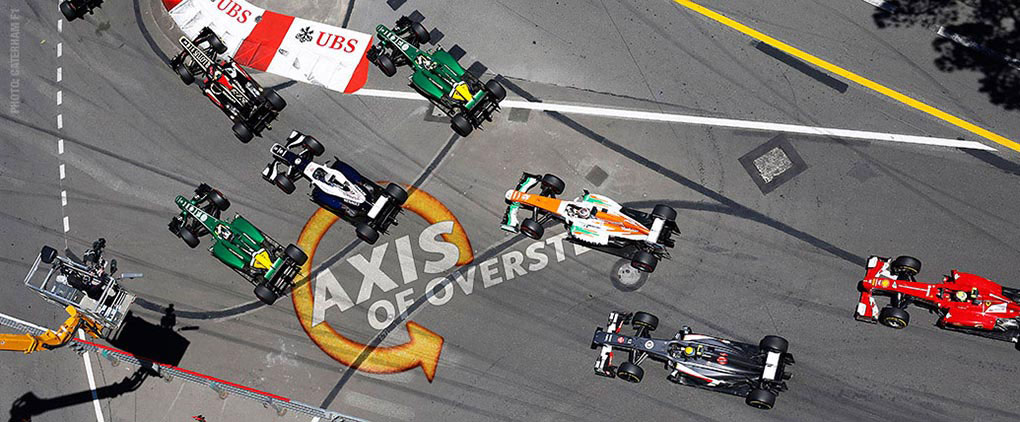
With the short lap and the first two tight corners, the first lap will be especially important as contact is almost inevitable.

Of the current drivers only Raikkonen, Button and Alonso have any experience there in a Formula 1 car, albeit in very very different machines.

nRelate Posts Only